
Indian Weddings
Planning a Baraat? Your celebration starts here!
We provide trained elephants throughout the US.
CALL NOW! 281-412-5200Booking elephants
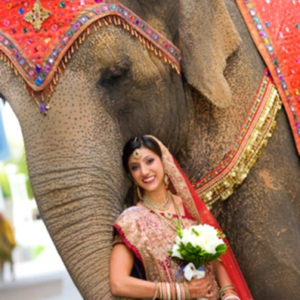
Riding an elephant at your wedding makes a statement... Unfortunately trained elephants are a rarity in the US and there’s only about 5 trainers who travel around the country. Because they’re so expensive to keep, bringing an elephant to your event start at $14,000 and up depending on your location. If your schedule is flexible, sometimes we can tap into a fair schedule and save several thousand dollars off the price. Most of our elephants have circus experience so they’re voice command trained and used to working in environments with people.
Lately some of our trainers have been targeted by animal activists who feel that riding an elephant is “animal cruelty” . As a result, it is impossible to get a permit to book them in some states. Some of our clients have been able to bypass these laws by contending that their religious freedom is being suppressed by not letting them follow their Indian traditions. You can rest assured that our trainers treat the pachyderms with respect and adhere to very strict rules of transporting them and feeding them.
Some of our elephants have Indian themed costuming, but not all of them. Let us know if that is something you need for your event. Some our clients have asked to be able to decorate the elephants with flowers. Let us know at the time of booking what you’d like to do.
CALL NOW! 281-412-5200
Book your elephant today!
[caldera_form id=”CF5c8e719d419ed”]Choose from these upgrades
Carriages
Book our carriages today for the best day you and your guests will remember

DJ
Our interactive DJ has just about every song you can imagine

DECOR
Looking for the perfect decor? We partner with the best event designers in Houston

Living Statues
Our living statues are the perfect addition to your decor and special day
State restrictions
State Restrictions Governing Traveling Shows and Circuses in the U.S. Expand- Prohibits any animal on public exhibit or display from coming into contact with the general public. (ARIZ. ADMIN. CODE R12-4-428.)
- Requires that all traveling acts notify animal control services 14 days prior to the first performance in a municipality. (CAL. HEALTH & SAFETY CODE § 25989.1.)
- Prohibits direct public contact with wild mammals or reptiles. Thus, photo-ops with these animals are prohibited. However, public contact with elephants is allowed. (DEL. CODE REG. §13-100-012 and policy.)
- Public contact with exhibited wild animals is permitted only if there is an experienced handler present with the exhibited animal. However public contact is permitted with leopards, lions, tigers, and jaguars weighing under 25 pounds; great apes less than 6 months of age and weight not more than 25 pounds; and gibbons and siamangs not less than 4 months of age and not more than 2 years of age. (FLA. ADMIN. CODE ANN. R. 68A-6.0023.)
- Prohibits direct public contact between the public and any animal identified as inherently dangerous. Inherently dangerous animals includes but is not limited to wolves, bears, primates, elephants, large cats, crocodiles. Thus, no photo-ops with inherently dangerous animals or elephant rides. Also, each non-resident circus or exhibitor must notify the Department of Natural Resources at least 5 days prior to entering the state or provide an annual itinerary or list of dates and locations for appearances in Georgia. (GA. CODE ANN. § 27-5-6 and policy.)
- Prohibits public contact with potentially dangerous wildlife. This does not include elephant rides. (CODE ME. R. § 09-137-007.)
- Prohibits direct public contact with exhibited animals that pose a safety risk to the public. These animals include cats, primates, bears, and all other carnivore species. However, public contact with elephants is not prohibited. (Policy.)
- Prohibits direct public contact with exhibited animals defined as inherently dangerous. Inherently dangerous animals includes, but is not limited to, primates, bears, wolves, and large cats. Thus, no photo-ops and leash walking of inherently dangerous animals. However, public contact with elephants is permitted. (CSMS 19-000-069 – Public Notice N. 3523.002.)
- Prohibits direct public contact with Class II wildlife. Class II wildlife includes copperhead snakes, cottonmouth snakes, timber rattlesnakes, pygmy rattlesnakes, massasauga rattlesnakes, mountain lions or mountain lion-hybirds, wolves or wolf-hybrids and black bears or black bear-hybrids. (MO. CODE REGS. ANN. tit 3, § 10-9, 220.)
- Prohibits public contact with wildlife except by a person who is licensed by the state. Thus, no elephant rides and photo opportunities where the general public is holding or touching an animal. (N.H. CODE ADMIN. R FIS 810.01.)
- Prohibits public contact with exhibited exotic and nongame wildlife. Thus, no photo-ops, leash walking or hand-feeding of these animals. However, elephant rides are banned only for animals with a history of injuring people. (Policy.)
- Prohibits public contact with wildlife. Wildlife does not include chimpanzees and elephants if these animals are under the immediate control of a handler. Covers photos and walking on leash. (58 PA. CODE § 147.282.)
- Prohibition on any person who houses, possesses, or is in direct contact with an elephant in a traveling show from using, or permitting an employee, agent, or contractor to use, a bullhook, ankus, baseball bat, axe handle, pitchfork, or other device designed to inflict pain for the purpose of training or controlling the behavior of an elephant. House Bill No. 8197, Session year: 2016
- Prohibits public displays of marine mammals. (S.C. CODE ANN. § 50-5-2310.) Circuses shall not be licensed for a time exceeding 48 hours at one place in any one year. (S.C. CODE ANN. § 52-1-30.)
- Public contact with Class I animals is prohibited except that public contact with lions, tigers, leopards, jaguars, cheetahs, cougars, and bears is permitted only with animal who are under twenty-five (25) pounds in weight and less than three (3) months of age. Class I wildlife includes large cats, great apes, wolves, bears, rhinoceroses, hippopotamus, crocodiles, alligators, poisonous snakes, and poisonous amphibians. (TENN. COMP. R. & REGS. 1660-1-18.04.)
- Prohibits public contact with dangerous reptiles and amphibians.